Fluid Ability/Intelligence
Fluid Intelligence has been defined as "the ability to perceive relationships independent of previous specific practice or instruction concerning those relationships." Fluid intelligence involves being able to think and reason abstractly and solve problems. Abstract reasoning involves being able to think in ideas and concepts. For instance, devising a marketing or HR plan involves thinking up, manipulating and sequencing ideas and concepts like target market, marketing mix, talent pipeline, recruitment strategy.
The most critical aspect of Fluid Ability is that it enables a person to problem solve independent of learning, previously existing knowledge, experience, and education. When you encounter an entirely new problem that cannot be solved with your existing knowledge, you must rely on fluid intelligence to solve it. You have nothing else to use, because the problem is new, and this precludes you from tapping into a knowledge or experience base with which to solve it.
https://www.verywellmind.com/fluid-intelligence-vs-crystallized-intelligence-2795004
According to Schneider & McGrew (2013, p. 772):
Fluid intelligence is the ability to solve unfamiliar problems using logical reasoning. It requires the effortful control of attention to understand what the problem is and to work toward a logically sound answer. People with high fluid intelligence can figure out solutions to problems with little instruction. Once they have found a good solution to a problem, they are able to see how it might apply to other similar problems. People with low fluid intelligence typically need hands-on, structured instruction to solve unfamiliar problems. Once they have mastered a certain skill or solution to a problem, they may have trouble seeing how it might apply in other situations. That is, their newfound knowledge does not generalize easily to other situations.
https://assessingpsyche.wordpress.com/2014/01/18/fluid-and-crystallized-intelligence-in-the-classroom-and-on-the-job/
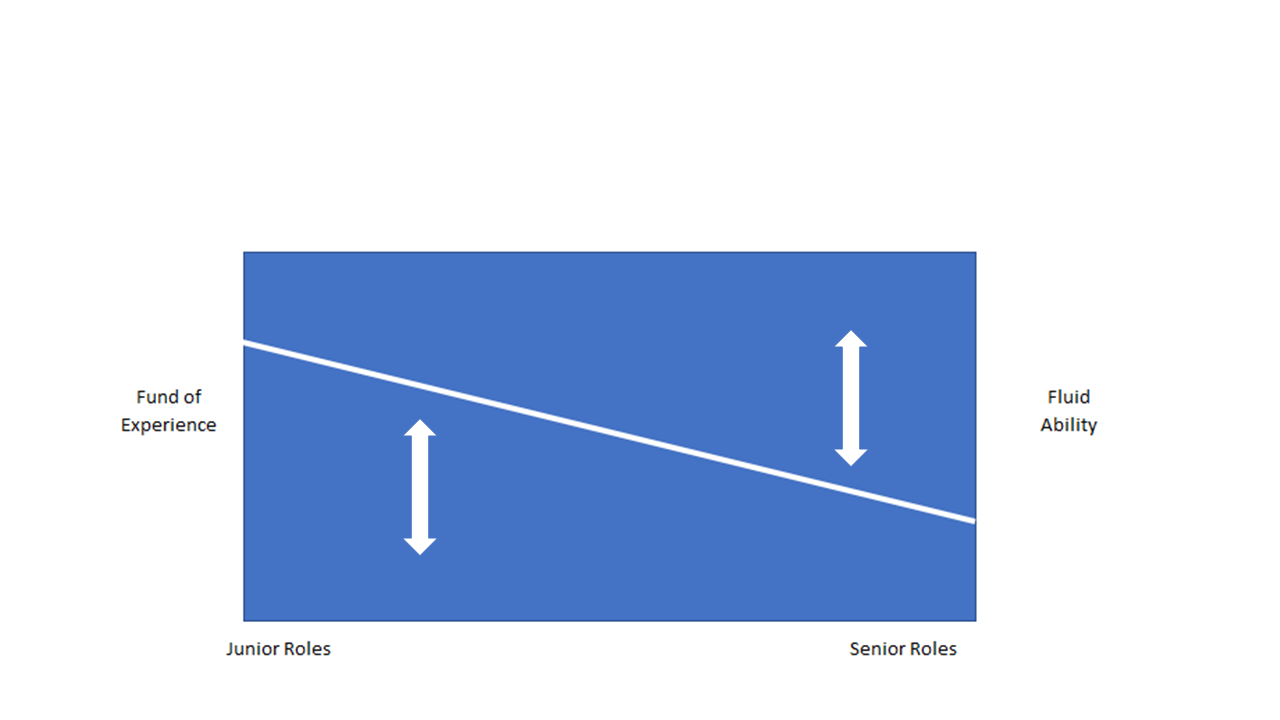
The more senior and the more complex jobs become, the more important fluid ability becomes. This stands to reason because as jobs become more complex, the more the incumbent must deal with curved balls, abstract problems, and new challenges that his experience bank has not prepared him to deal with.
Think for instance of an operator on a production line. Most problem solving is standard – apply the standard operating procedures and you will be fine.
A team leader however has some standard problems to deal with but also non – standard ones. It may not always be clear why a line is producing more scrap than before. He needs to “figure it out”. While experience will help, this time round the scrap problem may be different to the last time something like this happened.
A middle manager has even more non – standard events occurring and so on up the management chain. The primary tool for dealing with non – standard problems is fluid intellectual ability.
As a rule of thumb therefore the following applies:
⦁ The more senior a role, the more a person will need to tap into his fluid cognitive capability and the less his fund of past experience and skills, on their own, will equip him to perform the task at hand
⦁ The more junior a role, the more a person can “get away” with limited fluid ability, provided of course that he has a suitable fund of relevant experience and skills to draw on. Well-practised solutions usually cover most of the demands people need to cope with at lower levels.
Crystallized Intelligence
According to Kendra Cherry:
Crystallized intelligence involves knowledge that comes from prior learning and past experiences….Crystallized intelligence is based upon facts and rooted in experiences..… The more learning and experience you have, the more you build up your crystallized intelligence.
https://www.verywellmind.com/fluid-intelligence-vs-crystallized-intelligence-2795004
According to Schneider & McGrew (2013, pp. 772–773):
Crystallized intelligence is acquired knowledge. When people solve important problems for the first time, they typically remember how they did it. The second time the problem is encountered, the solution is retrieved from memory rather than recreated anew using fluid intelligence. Crystallized intelligence, broadly speaking, consists of one’s understanding of the richness and complexity of one’s native language and the general knowledge that members of one’s culture consider important. …A person with a rich vocabulary can communicate more clearly and precisely than a person with an impoverished vocabulary. A person with a nuanced understanding of language can understand and communicate complex and subtle ideas better than a person with only a rudimentary grasp of language. Each bit of knowledge can be considered a tool for solving new problems. Each fact learned enriches the interconnected network of associations in a person’s memory