The computer – brain analogy
A computer works much like the human brain. Information is loaded and stored on the computer’s hard drive in the form of software programs and information files, like say an Excel document.
This information (software and files) is retrieved and processed by the computer’s Central Processing Unit (CPU) to provide an output or solution, much like the visual at the bottom of this page.
A computers capability is determined by the capacity of its hardware - size of its hard drive, and the power of its CPU.
We can loosely think of cognitive capability in the same way. It is the capacity of our neural hardware – the brain – to acquire, learn and store information, learnings, skills, knowledge, experiences which we have defined as competencies,
AND
the capacity to engage in cognitive processes such as the ones we listed earlier to solve problems.
The power of the human “CPU and hard drive” will determine the extent to which a person can populate his brain with skills, knowledge, competencies and experience; the effectiveness with which he can utilise the foregoing; and very importantly his ability to take on problem solving challenges which are new or unfamiliar.
This is why employees with even high-level qualifications such as an MBA sometimes fail in their jobs. They may have the qualification, but they don’t have a big enough CPU to effectively utilize knowledge that sits in their memories as information, match it effectively to an external job demand, and process the external problem, together with their knowledge and together with whatever novel thinking is required, to come up with a solution.
This can happen at any level in an organisation, whether it is an operator who has been promoted into a team leader role and now has to learn new skills and how to use them to meet new job demands, or a senior manager who has been over – promoted and has insufficient “CPU” to deal with his problem solving demands.
It is critical therefore to ensure that a candidate or employee’s “computer hardware” is at least sufficient to deal with the problem-solving demands of his job. The only way to assess someone’s
LEVEL OF
cognitive ability is by means of an appropriate battery of psychometric tests. A cognitive psychometric test will provide us with a valid, reliable, and objective measurement, of a job candidate’s cognitive capability and enable us to make an informed judgement as to whether it is sufficient for a role.
Cognitive assessments therefore tell us about a person’s capability to effectively utilise the types of cognitive processes listed in the previous table. This capability will also tell us about a person’s ability to develop and utilize the acquired competencies needed for the job. The LEVEL at which a person needs to be able to engage in these processes depends on the LEVEL of the job.
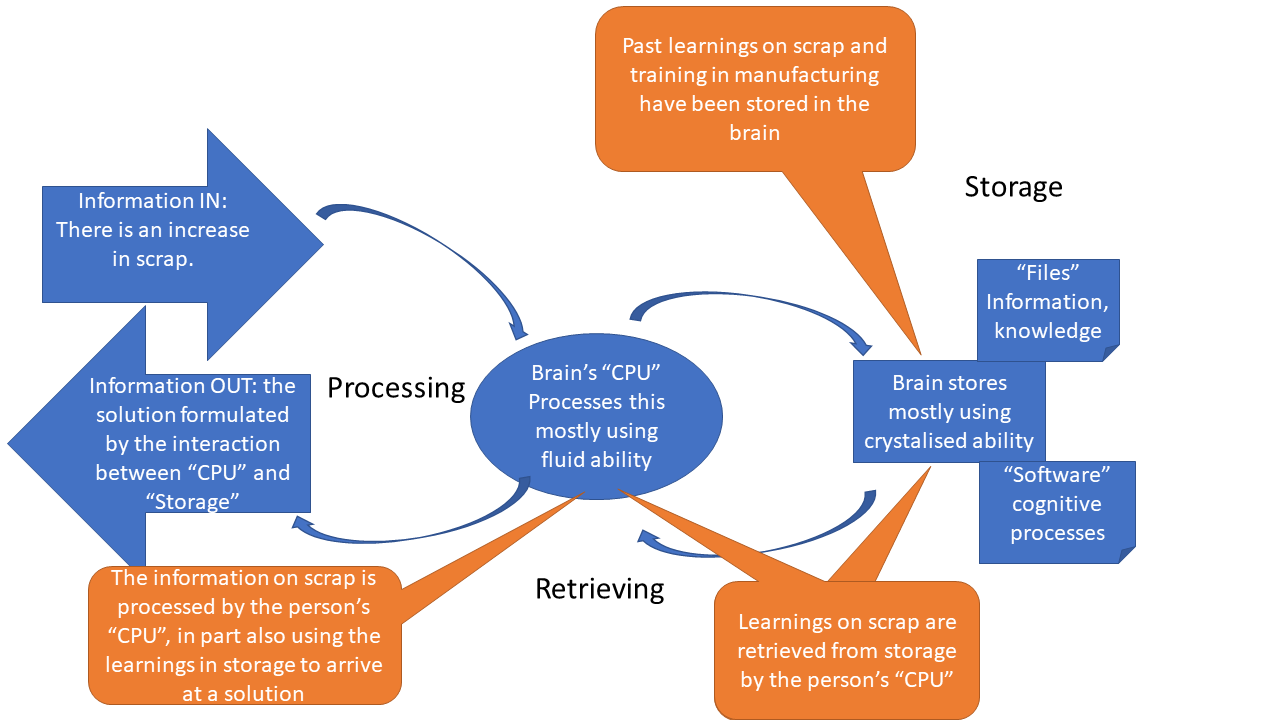
We can loosely think of cognitive capability in the same way. It is the capacity of our neural hardware – the brain – to acquire, learn and store information, learnings, skills, knowledge, experiences which we have defined as competencies,
And
The capacity to engage in cognitive processes such as the one’s we listed earlier in order to solve problems. In doing so it will typically - to a lessor or greater extent - draw on the competencies that have been stored in memory.
We have all experienced the frustration of our computer or smart device freezing, hanging or slowing down. This happens when the computer’s hardware is overloaded, overwhelmed and can’t cope with the demands made on it. This is exactly what happens when a person is overwhelmed and has “insufficient brain power” to cope with the problem solving demands the job makes on him.
The power of the human “CPU and hard drive” will determine:
- the extent to which a person can populate his brain with skills, knowledge, competencies and experience;
- the effectiveness with which he can utilise the foregoing;
- and very importantly his ability to take on problem solving challenges which are new or unfamiliar.
This is why employees with even high level qualifications such as an MBA sometimes fail in their jobs. They may have the qualification, but they don’t have a big enough CPU to effectively utilize the knowledge that sits in their memories as information, match it effectively to an external job demand,
and THEN PROCESS EVERYTHING...
the external problem, together with their knowledge and together with whatever novel thinking is required, to come up with a solution.
This can happen at any level in an organisation, whether it is an operator who has been promoted into a team leader role and now has to learn new skills and how to use them to meet new job demands, or a senior manager who has been over – promoted and has insufficient CPU to deal with his problem solving demands.