Introduction
Most organisations believe or assume that COMPETENCIES such as technical skills, qualifications, job knowledge and generic competencies are the key drivers of job performance.
As a result, they structure their selection processes around determining whether a candidate has the technical know – how to do the job.
However, …
While there is no doubt that COMPETENCIES are critical to job performance
Research very clearly shows that it is in fact CAPABILITY that is the key driver of job performance and differentiator between poor, average and good performers.
What do we mean? Let’s first have a quick look at what we mean by COMPETENCIES and CAPABILITIES.
Competencies vs Capabilities
Competencies (mostly the WHAT)
⦁ Competencies are learned and acquired through education, work and life experience
⦁ Competencies can be technical and specific to job families like HR, Management, Engineering, Quality, Logistics, Finance…..
⦁ Competencies can be generic and used in many different jobs across all the job families such as planning, organising, service orientation
Capabilities (mostly the HOW)
⦁ Capabilities are mostly inherent, in – born, hardwired in a person
⦁ Capabilities include, personality and emotional capabilities, values and interests (EQ)
⦁ Capabilities also include cognitive capabilities (IQ)
⦁ Cognitive and Personality/Emotional Capabilities have the strongest impact of all capabilities on job performance
Competencies (Mostly The What)
Technical/Job Specific:
⦁ Drawing up financial statements
⦁ Planning a production schedule
⦁ Developing a recruitment strategy
⦁ Analysing sales at an outlet
⦁ Doing a stock count
⦁ Producing an engineering drawing
Generic:
⦁ Planning
⦁ Organising
⦁ Commercial Awareness
⦁ Negotiating
⦁ Process Control
⦁ Service Orientation
⦁ Conducting Meetings
Capabilities (Mostly The How)
Personality and Emotional Capabilities: (EQ)
⦁ Resilience
⦁ Self Confidence
⦁ Emotional Control
⦁ Empathy
⦁ Interpersonal Awareness
⦁ Conscientiousness…
Cognitive: (IQ)
⦁ Fluid intelligence
⦁ Crystalized Intelligence
⦁ General Mental Capability
⦁ Cognitive Complexity
⦁ Specific Aptitudes
⦁ General Reasoning
⦁ Learning Potential….
As we have already stated, competencies no doubt play a critical role in determining individual job performance.
However, many studies show that CAPABILITIES are the key differentiators and play a much bigger role than COMPETENCIES in determining a person’s job performance. It is especially personality and emotional capabilities (EQ) + cognitive capabilities (IQ) that drive individual performance.
What does research tell us?
IQ (General Mental Ability)
Frank L. Schmidt and John E. Hunter are American Industrial/Organizational Psychology PhDs, and in 1998 they published “The Validity and Utility of Selection Methods in Personnel Psychology.” In this very wide - ranging study, where the effectiveness of many different assessment methods and tools were studied, they found that General Mental Ability is the strongest predictor of job success. They stated that:
The purely empirical research evidence in I/O psychology showing a strong link between General Cognitive Ability (GCA) and job performance is so massive that there is no basis for questioning the validity of GCA as a predictor of job performance. (The Role of General Cognitive Ability and Job Performance: Why There Cannot Be a Debate, Frank L. Schmidt)
EQ (Personality and Emotional Capability)
According to Daniel Goleman, psychologist and award - winning author of the book Emotional Intelligence EQ accounted for 67% of the abilities deemed necessary for superior performance in leaders and mattered twice as much as technical expertise.Law et al. (2004)[106] found that EQ was the best predictor of job performance beyond general cognitive ability among IT scientists in a computer company in China. Similarly, Sy, Tram, and O’Hara (2006)[104] found that EQ was associated positively with job performance in employees from a food service company.[109]
However, …
Many organisations don’t realise this and as a result place their selection focus on the tip of the iceberg:
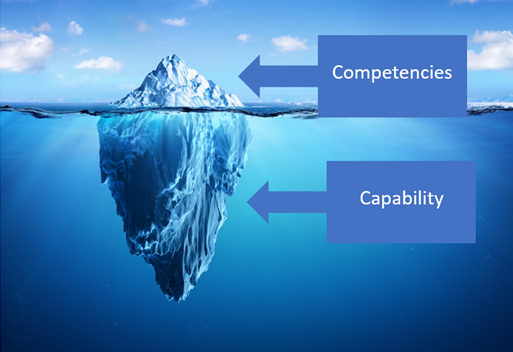
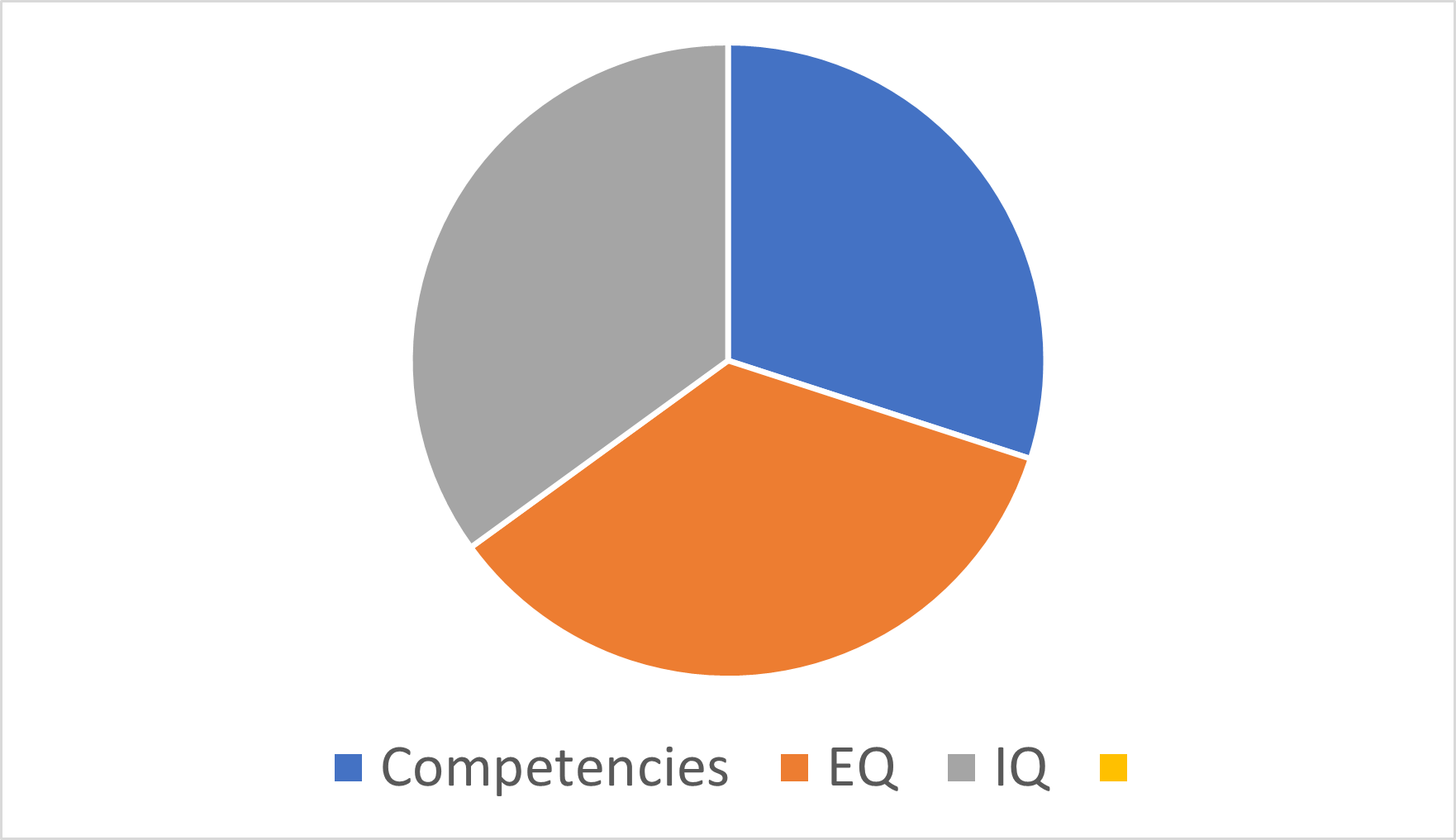
When the reality is that roughly two thirds of job performance is driven by people’s capabilities EQ + IQ = 68%), while about roughly only a third can be attributed to their competencies (experience = 18% and education = 10%).
One of the key consequences of emphasising COMPETENCIES while neglecting CAPABILITIES when recruiting is poor individual performance. But just how costly is that to organizations?