People either make or break organisations. Every person you take on board is either going to put wind in your sails or be a source of what we term “drag, drain and drift”. The cost of poor hiring decision is remarkably high. But just how bad is it?
Financial Costs
⦁ Recruitment agencies charge a 10 to 15% commission on annual remuneration for a successful placement.
⦁ Cost is doubled for bad hires as it would have to be duplicated for the bad hire’s replacement.
⦁ According to a Career Builder Survey 42% of companies report that a bad hire cost them at least R325,000.
⦁ 25% reported a loss of at least R700,000 when making a bad hiring decision.
It gets worse…
The Career Builder survey also found that:
⦁ 46% of 20,000 new hires failed within 18 months.
⦁ 81% of new hires were a disappointment due to average or marginal performance (Career Builder).
Then there are other costs….
Non-Financial Costs
The real damage is all the Non – Financial costs. They are difficult to properly quantify and also come in “under the radar” with the result that the deeper impact of a poor hiring decision is only seen months or years later.
As a result, organisations fail to pick up the causal link between poor hiring decisions and their adverse impacts, because the time span between cause and effect is too long to make the connection. We are talking about:
⦁ Wasted Salary Payments
⦁ resources wasted on performance management, disciplinary processes, CCMA disputes
⦁ decreased productivity
⦁ potential reputational damage
⦁ decreased teamwork
⦁ decreased morale
⦁ increased turnover
Many employers throughout the world, are currently using suboptimal selection methods, relying solely on unstructured interviews, when they could use more valid methods. In a competitive world, these organizations are unnecessarily creating a competitive disadvantage for themselves (Schmidt, 1993). By adopting more valid hiring procedures, they could turn this competitive disadvantage into a competitive advantage.
In economic terms, the gains from increasing the validity of hiring methods can amount over time to literally millions of dollars. However, this can be viewed from the opposite point of view: By using selection methods with low validity, an organization can lose millions of dollars in reduced production.
When it comes to combining predictors of success, two stand out. The combination of a General Mental Ability test and a personality test have a composite validity of 0.65.We will discuss this in detail in later modules.
Considering these high financial and non – financial costs, it seems obvious that organisations should as standard utilise a rigorous and well - designed selection process to ensure that they:
⦁ Bring good talent on board
⦁ Have the right fit between person and position
⦁ Keep “drag and drainers” out
So how exactly does your selection process stack up against best practice? Do you…
⦁ Use a job profile that identifies the competencies and capabilities that a candidate will need in order to be successful in the job?
⦁ Use a well - designed assessment process that makes use of multiple tools to ensure that the candidate matches up to the job profile or do you just “wing it” with an interview?
⦁ Assess the candidate for both competencies as well as capabilities such as cognitive ability and emotional intelligence?
⦁ Use the right tools for the job, or do you use the interview to determine practically everything you need to know about the candidate.
⦁ Have a system in place whereby you are able to integrate all candidate information into a coherent and informed decision? Or do you just go by your gut feel?
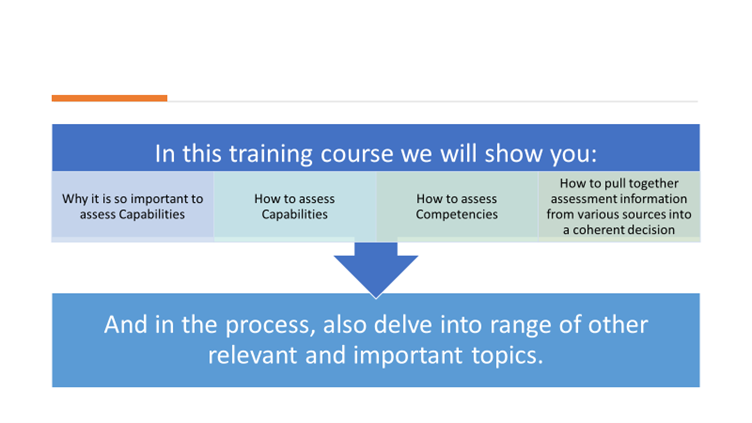
In this course we will show you that any selection process that:
⦁ Does not utilise a job profile to clearly identify the job requirements.
⦁ That relies solely or mainly on an interview.
⦁ Does not assess Capabilities in addition to Competencies.
⦁ Does not have a system for integrating assessment information gathered on the candidate into an informed decision,
without a doubt greatly increases the risk of making a poor hiring decision and incurring the attendant consequences.